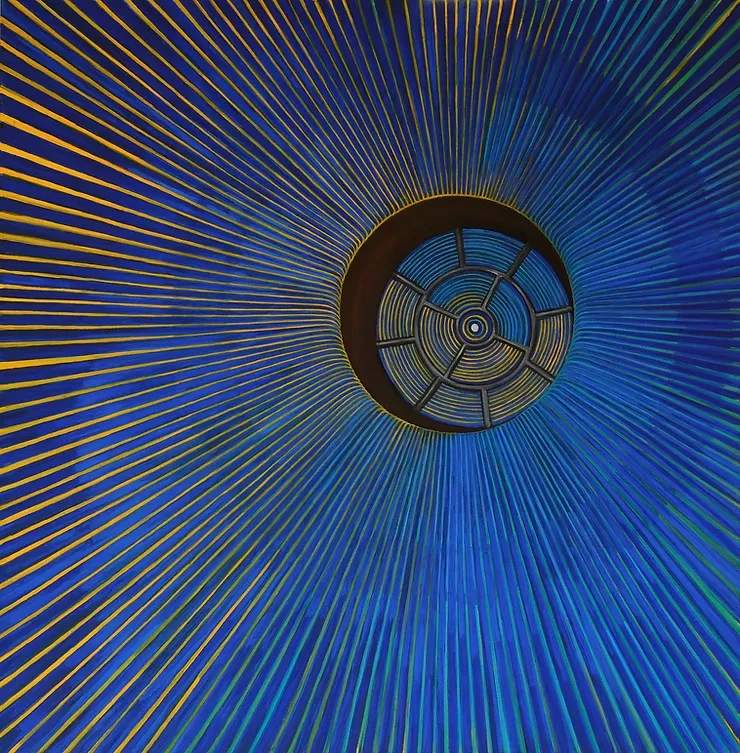
Progressive Overdrive: oil on canvas, 110X110 cm

Neil Armstrong setting foot on the moon on July 26th 1969 represents an event that will forever remain unique in history: the first time a human being stood on the surface of another celestial body. It will be one of the few moments that will still be discussed and celebrated in another fifty years, in another hundred years and, hopefully, even in another thousand years time.

Despite it having occurred over fifty years ago, the Apollo 11 Mission is a pinnacle of human engineering achievement. Indeed many would argue ‘over achievement’ as we have not returned since the last Apollo mission left the surface of the moon on 13th December 1973.

Progressive Overdrive is a study of the interior of the thrust chamber of an F-1 rocket engine. Five of these unprecedentedly powerful engines propelled the Saturn V booster launching the Apollo 11 spacecraft on its 1/4 million kilometre journey to the moon.

In Progressive Overdrive I chose ultramarine/lapis lazuli and gold for their historical religious/devotional associations in art. Lapis Lazuli was used by some of the most important artists of the Renaissance and Baroque, including Masaccio, Perugino, Titian and Vermeer where these artists often reserved the colour for the clothing of the central figures of their paintings – typically the Virgin Mary.

The paintings of the Renaissance were often intended to inspire and educate the viewer with an understanding of the Christian world view – an often absolutist, dogmatic perspective at odds with the dynamic, evolving, evidence driven scientific world view that, ultimately, enabled us to walk on the moon.

My use of Lapis and gold takes this association and creates a devotional/inspirational work where the ‘religious’ object is a manifestation of progress – progress driven by our scientific understanding of the universe that lead to technological innovation which was then coupled with an extraordinary application of human effort.

Progressive Overdrive is an attempt to create an inspirational work that is at once dramatic and uplifting but also enigmatic and mysterious.

Related Posts

Check out our Latest News

‘Sekhmet Waits: She who loves Ma’at: She who is powerful: a triptych’: oil on aluminium, 90X120cm ea

Egyptian mythology is woven in with Japan’s Super Kamiokande Neutrino Detectors. Sekhmet was the lion-headed Egyptian goddess of hot desert sun, plague, chaos, war and healing. She was created to destroy humans for not living in accordance of principles of goddess Ma’at.

Ma’at was the goddess of truth, justice, balance and order. She was more than just a goddess to ancient Egyptians who beloved that universe had an order and it was Ma’at who kept everything in balance. This helped ancient Egyptians develop a strong sense of morality and justice.

I believe these ancient goddesses have tales to heed. Thousands of years of a society structured by patriarchal values that uphold the power and heroism of men and deliberately diminish the value of women has created a twisted self-serving monocled view of the world that seems almost childlike in its inability to comprehend the seriousness of challenges that lie ahead.

For almost 30 centuries—from its unification around 3100 BCE to its conquest by Alexander the Great in 332 BCE, ancient Egypt was the preeminent civilisation in the Mediterranean world. Female pharaohs were quite common and common women of ancient Egypt could have their own businesses, own and sell property, and serve as witnesses in court cases. They were permitted to be in the company of men. They could escape bad marriages by divorcing and remarrying. And women were entitled to one third of the property their husbands owned. The political and economic rights ancient Egyptian women enjoyed make them the most liberated females of all time.

‘Once Upon a Time, Over the Gravity Well and Far Away – a diptych’, oil on aluminium, 90X145cm each

‘Once Upon a Time, Over the Gravity Well and Far Away: a diptych’, oil on aluminium, 90X145cm each, 2021

This is one of the most important commissions I have done to date as it is for Jennifer Goldsmith-Grinspoon and David Grinspoon. David’s books (EARTH in HUMAN HANDS, Chasing New Horizons), science and philosophy have been instrumental in shaping my creative practice and my worldview.

I wanted the diptych to capture the unique fairy tale-like quality of Arecibo telescope’s ( The Arecibo Observatory) brief existence, its wondrous discoveries beyond our gravity well, and its rather dramatic conclusion.

I chose the title of the diptych from Ian M Banks, ‘Use of weapons’ a Culture novel, where Zakalwe the main protagonist tells a despot on a planet far, far away a story which at first appears to be a fairy tale but is really a description of Culture, a utopian, post-scarcity space society of humans, aliens, and advanced superintelligent artificial intelligence living in artificial habitats spread across the Milky Way galaxy. , ‘Once upon a time, over the gravity well and far away, there was a magical land where they had no kings, no laws, no money and no property, but where everybody lived like a prince, was very well-behaved and lacked for nothing. And these people lived in peace, but they were bored because paradise can get that way after a time, and so they started to carry out missions of good works; charitable visits upon the less well-off, you might say; and they always tried to bring with them the thing that they saw as the most precious gift of all; knowledge; information; and as wide a spread of that information as possible, because these people were strange in that they despised rank, and hated kings . . . and all things hierarchic’

I chose a quote from this book as the title for the diptych for not just the obvious hope one has that someday we humans might achieve, or at least set ourselves on the path to, the hopeful future powered by knowledge as imagined by Iain M Banks in his Culture series.

The title and the source of the title become significant for me as I find the same sense of joy in knowledge and optimism regarding humanity’s future in David Grinspoons books.

‘Mimir’s Well: a Triptych’, oil on aluminium panel, 80X120 cm each, 2019

‘I know where Odin’s eye is hidden, Deep in the wide-famed well of Mimir;

In Norse mythology Odin’s thirst for wisdom is almost insatiable. In one story Odin sacrificed his eye in return for a drink from Mimir’s well and the cosmic knowledge that he would attain from taking such a drink. Mimir is a mysterious being whose knowledge of all things was practically unparalleled among the inhabitants of the cosmos.

Looking at the Super-Kamiokande an extraordinary apparatus designed to detect Neutrinos, some of the most elusive and mysterious particles in the universe, I was reminded of the story of Mimir’s Well. There was the pool of ultrapure water (50,000 tonnes of it) in an immense cavern 40m high buried 1000m below ground where 11,146 photomultiplier tubes wait to detect the interaction of a neutrino that has potentially travelled millions of light years from an exploding star situated on the other side of the galaxy.

The nature of those interactions may reveal information that deepens our understanding of the universe – just as Mimir’s Well promised Odin cosmic knowledge that he was willing to sacrifice so much for. So much effort, so much sacrifice to produce these amazing devices.

I decided on the triptych format for my paintings of the detector as it appropriates a form popular in Christian art as a way to display religious imagery behind an altar, again referencing/combining both themes within the Norse mythological story of Mimir’s well and the scientific effort that is the ‘religious quest’ in our post-religious world today.